Why a mini-machine
A small, silent PC that's on all the time and becomes your AI-assisted development workshop. The goals, the philosophy, and why it changes the way you tinker.
In this guide

Guide checked 3 months ago: some commands may have changed. Let us know if so.
In short
A mini-machine is a small, silent PC that stays on around the clock and hosts a coding agent, your projects and, if it has enough memory, local AI models. It is a sandbox where the agent can work on its own without touching your main computer. For an agent wired to a cloud model, an entry-level 16 GB mini-PC is enough; to run real models at home, the memory shortage has pushed prices up: count on roughly €1,400 for 32 GB and €2,200 for 64 GB of unified memory (prices checked on 30 September 2026).
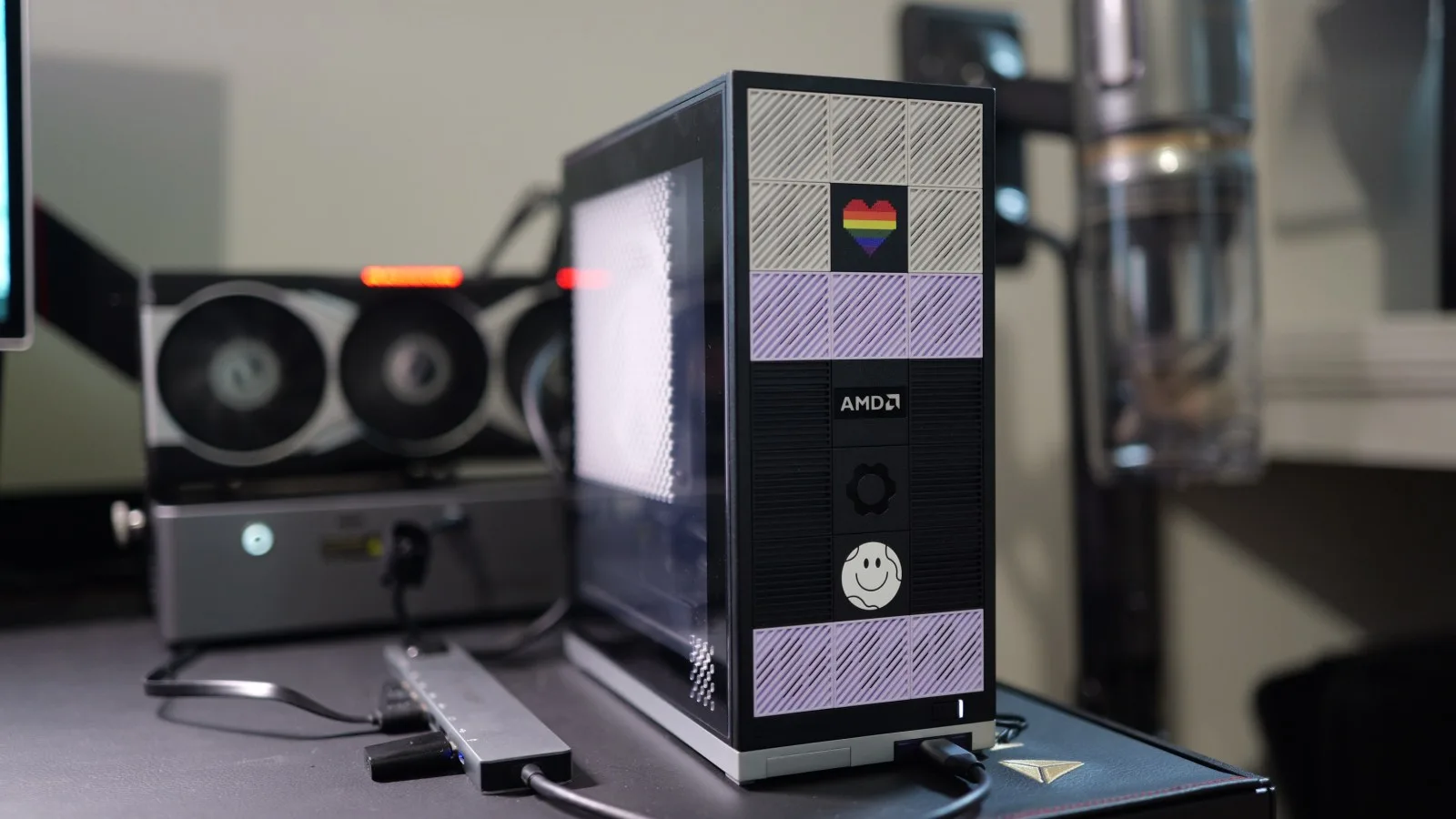
Picture a little box sitting in a corner of your desk. It makes no noise, it draws less power than a light bulb, and it’s on 24/7. Inside: a coding agent that speaks your language, AI models running locally, and everything you need to turn an idea into a deployed project. That’s a mini-machine. And once you’ve had a taste, you’ll wonder how you ever managed without it.
The idea in one sentence
You describe a project in plain language, the agent builds it, and you deploy it on your own domain name, all on a machine that belongs to you, that never sleeps, and that costs almost nothing to run.
This isn’t a geek fantasy. It’s possible because three things came together: genuinely capable coding agents, open AI models that fit in 32 to 128 GB of memory, and mini-PCs able to host them. Take these three ingredients, plug them together, and you get a personal workshop.
Why a dedicated machine, and not your laptop?
It’s a fair question. You already have a computer. Why add another one?
- It’s always on. Your agent can work while you sleep, a build can run overnight, a service can stay online. Your laptop, on the other hand, you close it and walk away.
- You can reach it from anywhere. From the couch, the train, the office, the machine is reachable (privately and encrypted, we’ll cover that with Tailscale). It’s your personal server, not an object sitting on a table.
- It doesn’t eat into your laptop. Running a local AI model heats things up and drains the battery. On a dedicated machine, your portable stays cool and available for everything else.
- You can break things without flinching. This is the most liberating part. It’s not your everyday machine. You test a weird network config, install something sketchy, reformat? No consequences for your real digital life. The right to make mistakes is what makes you learn fast.
- You can give the agent free rein. This is the reason that changes everything for anyone who wants to automate. On your personal laptop, the one that holds your email, your photos, your bank access, you’d never dare give an agent broad permissions to act on its own. On a dedicated machine, you can. You hand the orchestrator advanced permissions, you let it install, configure, deploy, run autonomously, because the worst that can happen is having to reformat a box that holds nothing precious. That’s what unlocks truly autonomous agents (we talk about it in Agents running on the mini-PC).
Silent, frugal, and cheap
The numbers matter, so here they are without the wrapping. A modern mini-PC draws 10 to 30 W at idle, the cost of a night light on your bill, even running around the clock. It’s nearly silent, often passively cooled or with a fan you can’t hear.
As for the purchase price, it all depends on what you ask of it:
- To host the agent and your projects, with the AI model in the cloud, an entry-level 16 GB mini-PC does the job, and so does an old recycled PC. That stays in the few-hundred-euro range.
- To run real models locally, memory is what costs money, and the memory shortage has pushed prices up. Reference prices checked on 30 September 2026 for the Framework Desktop, without SSD or operating system: €1,429 with a Ryzen AI Max 385 and 32 GB, €2,209 with a Ryzen AI Max+ 395 and 64 GB, €3,889 with 128 GB. At Apple, the Mac mini M6 starts at €1,049 with 16 GB.
The machine-by-machine detail, and what each one can run, is on Quelle IA, “local AI” section (in French). We come back to it in Choosing the hardware.
Compare that to a cloud server you pay for monthly, for life, without ever owning anything. Here, you buy once, and the machine is yours.
What you’ll be able to do
Concretely, once you’ve finished the path:
0 of 3 steps done Your ticks stay in this browser.
-
Describe a project in plain language
“Build me a small site that aggregates my RSS feeds and summarizes the articles.” The agent scopes it, codes, tests, and loops until it works. Your job: review and validate.
-
Deploy it on your domain
No “localhost” that only you can see. With a Cloudflare tunnel, your project lives on a real URL, accessible and encrypted, without opening a single port on your router.
-
Run AI locally
AI models that answer from your machine, free, private, offline. Your data never leaves home. Perfect for sensitive stuff, or just to depend on no one.
The philosophy: the machine is cheap, the skill is precious
Here’s the idea that holds the whole project together. The hardware costs next to nothing. What has value is what you learn to do with it.
The real skill isn’t knowing commands by heart, the agent knows them better than you. It’s knowing how to scope a project: framing the right problem, breaking it into steps, reviewing a plan, telling when it’s right and when it’s going off the rails. We dedicate a whole guide to it, and it’s probably the most important of the lot: Scoping with an LLM.
Who is it for?
For the curious. You don’t need to be a sysadmin: that’s the whole bet of this site. At every technical step, the agent walks with you: it explains, it proposes, you review. If you can read a paragraph and click “yes” knowing what you’re doing, you can do this.
Concretely, it speaks to the folks at Humanoid, to journalists who want a custom tool, to developers looking for a personal lab, and to all the weekend tinkerers who love understanding how things work.
What it isn’t
To close, a mini-machine does not replace the cloud. The big hosted AI models (Claude, GPT) remain more powerful than what runs locally, and some pro services do things a box sitting on a desk never will. To gauge the current gap between the best online models and the ones you install at home, the Quelle IA ranking of local models (in French) is updated every week. We’re not selling you total independence.
What we’re offering is a sovereign turf: a space you control, where you experiment freely, where your data stays home, and where you learn for real. The cloud for raw power, your mini-machine for freedom. The two coexist just fine.
What to expect
A weekend to set it all up. A lifetime to enjoy it. The path is split into short guides: you move at your own pace, and each one leaves you with a machine a little more capable than the day before.
All the commands in this guide
Frequently asked questions
Why use a dedicated machine for AI instead of your laptop?
A dedicated machine stays on around the clock, can be reached from anywhere and keeps your laptop cool while a model runs. Above all, it holds nothing precious: you can break things on it without consequences and give an agent broad permissions to work on its own, which nobody would dare on the computer that holds their email and banking logins.
How much power does a mini-PC use when it runs 24/7?
A modern mini-PC draws 10 to 30 W at idle, about what a night light adds to the electricity bill, even when left on permanently. It is also nearly silent, often fanless or fitted with a fan you cannot hear.
Does a local AI model replace Claude or ChatGPT?
No. Large cloud-hosted models such as Claude or GPT remain more powerful than what runs on a personal machine. Local gives you the freedom to experiment and keeps your data at home, the cloud brings raw power, and the two coexist very well.
Do you need to be a sysadmin to set up a mini-machine?
No. At every technical step, the coding agent explains, suggests the commands, and you review them before approving. Being able to read a plain-language explanation and approve an action knowingly is enough, and setting everything up takes about a weekend.
What can you actually do with a mini-machine?
Describe a project in plain language and let the agent scope it, code it and test it until it works. Then publish it on your own domain name through a Cloudflare tunnel, without opening a port on your router. And run AI models locally, free and private, so your data never leaves your home.
Terms in this guide: AgentOrchestratorSkill
Spotted a mistake?
A command stopped working, a price changed?
Tools change every month. Tell me what is wrong in this chapter and I will fix it and update its date.